
Views: 0 Author: Site Editor Publish Time: 2026-10-08 Origin: Site


Miscalculating linear motion parameters carries severe engineering consequences on the shop floor. Confusing thread geometry metrics often leads to incorrect motor sizing, positioning errors, and premature mechanical failure. Industry professionals frequently conflate pitch and lead in linear motion specifications. While these terms are interchangeable in standard fasteners, they represent distinct variables in rolling-element assemblies. This distinction becomes critical when evaluating multi-start configurations for automation equipment. Mastering the difference between ball screw pitch vs lead is mandatory. It allows engineers to optimize speed, load capacity, and precision without over-specifying components. This guide provides a technical evaluation framework. It helps you select between single-start and multi-start designs based on strict application requirements, ensuring your mechanical system performs exactly as engineered from day one.
The Fundamental Distinction: Pitch is the axial distance between adjacent thread grooves; lead is the linear distance the nut travels in one complete 360-degree revolution.
The Multi-Start Multiplier: In single-start ball screws, lead equals pitch. In multi-start designs, lead equals the pitch multiplied by the number of thread starts.
Speed vs. Resolution Trade-off: Higher leads (often achieved via multi-start designs) provide faster linear speeds at lower motor RPMs but sacrifice fine positioning resolution and require higher driving torque.
Back-Driving Risks: Multi-start ball screws with high leads are highly efficient but prone to back-driving under vertical loads, requiring supplementary braking systems.
Accurate component specification requires baseline definitions. Establishing these definitions eliminates vendor-buyer miscommunication and ensures the mechanical system performs exactly as engineered. Thread geometry directly dictates kinematic performance. Understanding these metrics prevents catastrophic design failures during the prototyping phase.
Pitch is a strict geometric measurement. It represents the axial distance from the crest of one thread groove to the crest of the next adjacent groove. This measurement remains constant regardless of the number of thread starts on the shaft. Pitch dictates the physical space available between threads, which in turn governs the internal geometry of the entire assembly.
This geometric constraint determines the maximum size of the ball bearings you can use inside the nut. Larger pitches accommodate larger ball bearings. Larger bearings generally offer higher load capacities because they distribute forces over a wider surface area. The pitch also influences the raceway radius and the conformity ratio between the ball and the gothic arch thread groove. These factors directly impact the dynamic load rating and the overall lifespan of the linear actuator.
You can determine pitch in the field using a straightforward measurement technique. Do not rely on a single thread measurement, as minor manufacturing tolerances can skew the result. Instead, measure a specific axial length along the screw shaft using precision digital calipers. Count the number of thread grooves within that measured length. Divide the total length by the number of grooves. This calculation provides the exact pitch measurement for replacement or reverse-engineering purposes.
Lead is a functional kinematic measurement. It defines the exact linear travel distance achieved by one full 360-degree rotation of the screw shaft. Alternatively, it is the distance the nut travels when rotated once around a stationary shaft. Lead represents the actual output motion of the system and is the primary variable for motion control programming.
This metric directly dictates the linear velocity of the mechanical system. It establishes the hard mathematical relationship between motor RPM and linear speed. A higher lead translates to faster linear motion for a given motor speed. Engineers use the lead value to program servo drives, set encoder feedback loops, and configure stepper motor controllers. It is the fundamental variable for calculating machine cycle times, acceleration profiles, and exact positioning coordinates.
The relationship between these two metrics relies on a simple equation. This formula applies to all helical thread designs across the mechanical engineering spectrum. The core formula is: Lead = Pitch × Number of Starts.
Consider a practical calculation example for a standard ball screw assembly. Assume the shaft features a 5mm pitch. If the shaft utilizes a single-start design, the lead is exactly 5mm. If the shaft utilizes a 2-start design, you multiply the 5mm pitch by 2. This yields a 10mm lead. A 4-start design with the same 5mm pitch results in a 20mm lead. The pitch remains identical, meaning the ball bearing size stays the same, but the linear output changes drastically per revolution.
Structural differences in thread architecture fundamentally alter mechanical performance. Engineers must categorize these solutions to match application demands accurately. Each design offers specific advantages regarding torque requirements, maximum speed limits, and load distribution capabilities.
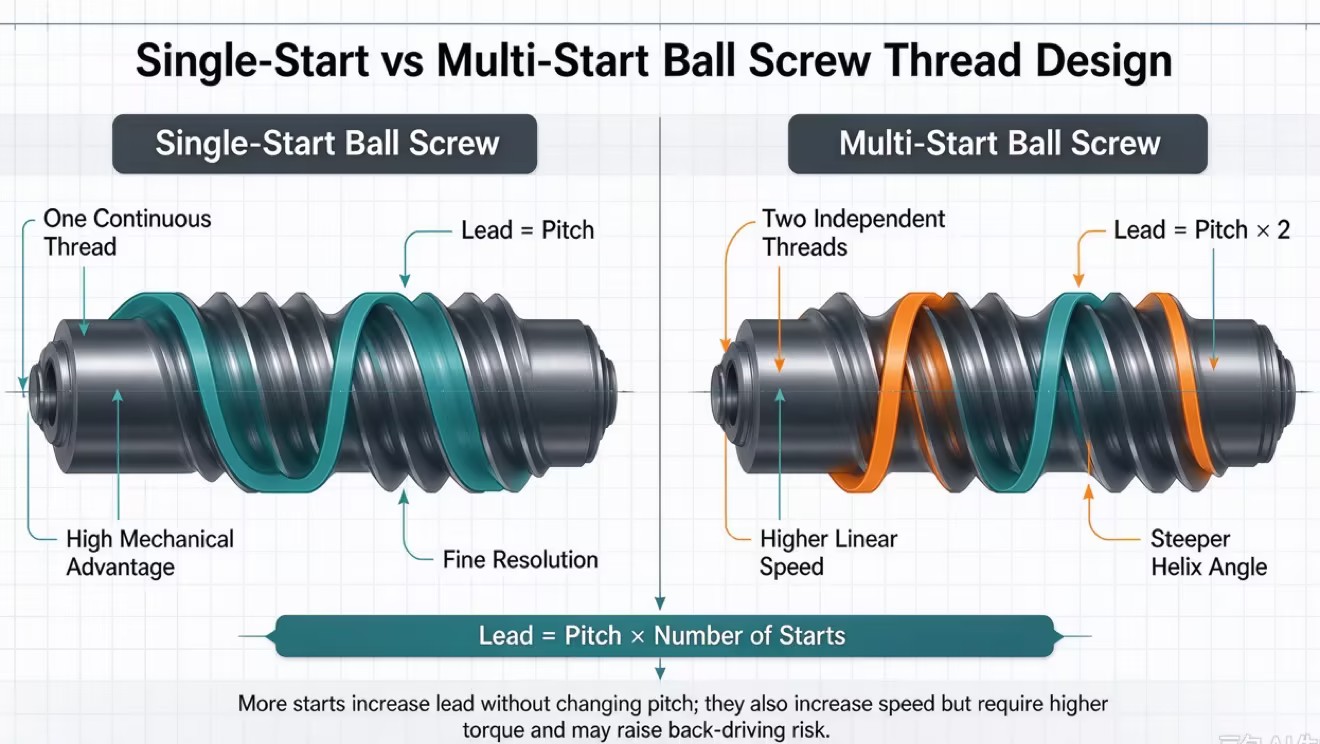
Single-start ball screws feature one continuous helical thread, with lead equal to pitch. Their low lead provides greater mechanical advantage, requiring less driving torque while delivering high thrust and precise positioning. They are ideal for heavy-load applications, CNC machines, industrial presses, and precision motion systems.
Multi-start ball screws feature two or more parallel helical threads, allowing higher linear speeds without increasing motor RPM. Although they require greater driving torque, they are well suited for high-speed automation, packaging machinery, laser cutting systems, and pick-and-place applications.
Single-start and multi-start ball screws can be identified by counting the independent thread starts at the shaft end. A single-start screw has one thread start, while two-start and four-start designs have two and four evenly spaced starts, respectively. This inspection helps verify specifications and prevent replacement or installation errors.
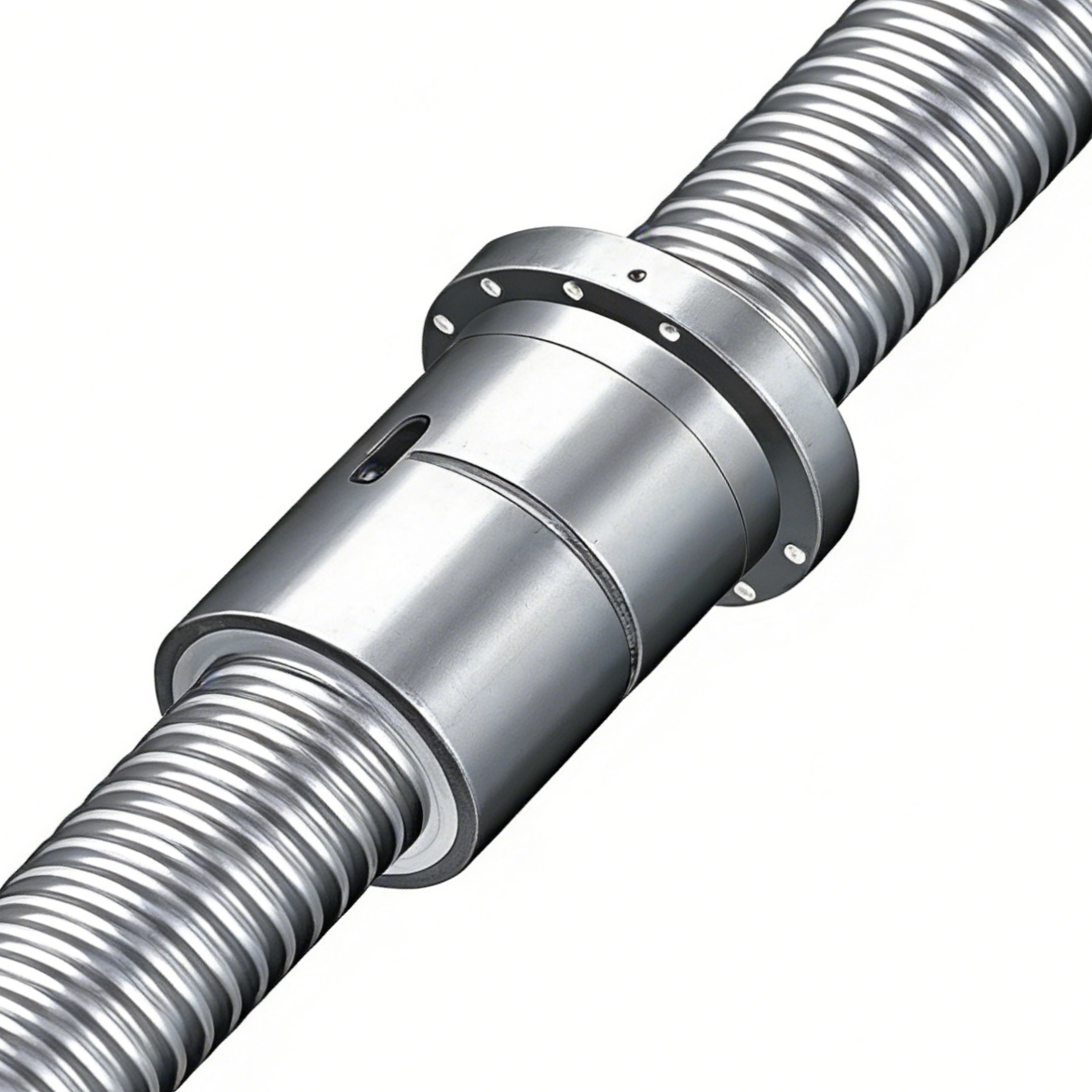
Selecting the right component requires mapping specific features to operational outcomes. System scalability depends on balancing competing mechanical properties. Engineers must evaluate speed, load, resolution, and efficiency simultaneously to design a robust linear actuator.
Multi-start ball screws achieve higher linear speeds without increasing motor RPM. This helps prevent critical speed issues, shaft vibration, and excessive wear on ball return mechanisms, improving mechanical stability and extending service life.
Multi-start ball screws can distribute axial loads across multiple ball tracks, potentially improving load capacity. However, actual performance depends on nut length, active ball circuits, and preload. Engineers must verify dynamic and static load ratings to ensure sufficient stiffness and durability.
Lower-lead ball screws provide finer positioning resolution, while higher-lead multi-start designs prioritize speed. High-lead screws require higher-resolution encoders and precise motion control to maintain positioning accuracy, potentially increasing system complexity and cost.
Ball screws typically achieve over 90% efficiency due to low rolling friction. However, high-lead multi-start designs are more susceptible to back-driving under axial loads. Vertical applications require appropriate holding brakes or counterbalance systems to prevent uncontrolled movement during power loss.
| Feature | Single-Start Design | Multi-Start Design |
|---|---|---|
| Lead vs. Pitch | Lead = Pitch | Lead = Pitch × Number of Starts |
| Linear Speed | Lower (requires higher RPM) | Higher (achieved at lower RPM) |
| Mechanical Advantage | High (requires less torque) | Low (requires more torque) |
| Positioning Resolution | Excellent (sub-micron capable) | Lower (requires high-res encoders) |
| Back-Driving Risk | Low to Moderate | High (brakes often mandatory) |
| Helix Angle | Shallow (typically under 5 degrees) | Steep (often exceeding 10 degrees) |
Improper specification carries hidden costs and harsh engineering realities. Overlooking system dynamics leads to catastrophic failures on the production line. Engineers must address motor sizing, lubrication, and backlash proactively. Implementing strict mitigation strategies protects the mechanical investment and ensures uptime.
Multi-start ball screws require higher driving torque and careful motor matching due to their larger lead. Since reflected inertia increases with the square of the lead, engineers must recalculate torque and inertia requirements to prevent motor stalling, servo instability, and overheating.
High-lead ball screws operate at higher speeds, generating more friction, heat, and wear. Proper lubrication is essential to maintain performance and extend service life. High-speed applications may require specialized greases, continuous lubrication, or additional cooling systems.
Preload minimizes backlash and improves positioning accuracy and rigidity. Common methods include oversized balls and double-nut configurations. However, multi-start ball screws require tighter manufacturing tolerances to ensure even load distribution, increasing production complexity and cost.
Understanding broader category decisions ensures comprehensive system alignment. It justifies component costs to project stakeholders and purchasing departments. Engineers must evaluate friction types, efficiency metrics, and maintenance requirements. This baseline context validates the upgrade to rolling-element technology.
The fundamental difference lies in the type of friction generated during motion. A ball screw utilizes rolling friction. It features point contact via the hardened steel balls rolling between the nut and shaft raceways. A lead screw relies on sliding friction. It features broad surface contact between the internal threads of the polymer or bronze nut and the external threads of the stainless steel shaft.
This structural difference creates a drastic gap in friction coefficients. Rolling friction is minimal, typically around 0.003. Sliding friction is substantial, often exceeding 0.10. Lead screws typically operate at 30% to 50% efficiency. They generate significant heat and wear over time, requiring frequent nut replacement. However, lead screws are highly cost-effective and immune to catastrophic ball-jamming failures. You should downgrade to a lead screw only for cost-sensitive projects, low duty cycle applications, or when inherent self-locking capabilities are required to prevent back-driving without external brakes.
Upgrading to rolling-element technology requires financial justification. This is especially true in CNC machining, semiconductor manufacturing, and advanced automation. Use this rapid evaluation checklist to determine if the investment yields a positive return. If your application triggers these requirements, the upgrade is mandatory.
Higher Efficiency: The system requires maximum power transmission with minimal energy loss, allowing you to downsize the servo motors and drives.
Lower Friction: The application demands smooth motion without stick-slip phenomena at low speeds, critical for optical scanning or 3D printing.
Strict Repeatability: The process requires returning to exact coordinates consistently over millions of cycles without compensating for wear.
High-Speed Continuous Operation: The duty cycle involves rapid movements with minimal dwell time, which would melt a standard polymer lead screw nut.
Near-Zero Backlash: The machining or positioning task requires absolute rigidity during direction reversals to prevent chatter marks on the workpiece.
Pitch is a strict geometric constraint that dictates internal bearing size. Lead is the functional driver of linear motion that dictates speed and resolution. Conflating these terms leads to systemic design failures, stalled motors, and shattered components. The choice between single and multi-start architectures hinges entirely on balancing your mechanical requirements. You must weigh required speed, available torque, and positioning resolution against each other to find the optimal configuration.
Apply strict shortlisting logic to your design process. Choose a single-start design for high thrust applications, fine resolution requirements, and vertical loads where back-driving poses a severe safety risk. Choose a multi-start design for high-speed automation and rapid-traverse applications where motor RPM must remain low to avoid resonance and whirling.
Calculate your required linear velocity and maximum motor RPM to determine the minimum acceptable lead for your application.
Compute the reflected load inertia to ensure your selected servo motor can handle the acceleration profile without stalling.
Evaluate your vertical load requirements to determine if a mechanical holding brake or counterweight system is necessary for safety.
Download the manufacturer's CAD models and dynamic load-rating charts to verify physical fit and calculate the theoretical L10 lifespan of the assembly.
A: Confusing pitch and lead results in incorrect torque and inertia calculations. If you use pitch instead of lead for a multi-start screw, you will drastically undersize the motor. This causes the motor to stall, overheat, or fail to achieve the required linear velocity and acceleration.
A: Yes, but it requires a very large pitch. A large pitch demands larger ball bearings and a thicker screw shaft. This increases the overall footprint and weight of the assembly. Multi-start designs achieve high leads while maintaining a smaller pitch and compact profile.
A: Multi-start screws have a much steeper helix angle. This steep angle reduces the mechanical friction that naturally resists reverse motion. Under an axial load, especially in vertical applications, this low resistance allows the load to force the screw to rotate backward freely.
A: The number of starts increases the number of independent ball tracks. This can distribute the load across more parallel circuits. However, total load capacity depends on the total number of active load-bearing balls within the nut, which is constrained by the nut's physical length.
A: Conceptually, yes. Both define the axial distance between adjacent thread crests. However, ball screw pitch specifically accommodates rolling ball bearings, requiring precise raceway profiles. Fastener pitch is designed for static surface friction and clamping force, not continuous kinetic motion.
A: Look directly at the flat end face of the screw shaft. Count the number of distinct thread grooves that begin at the perimeter. One groove indicates a single-start screw. Two or more independent grooves indicate a multi-start configuration.
A: Yes. The nut must have independent internal return circuits for each thread start. A two-start screw requires a nut with at least two separate ball recirculation paths. This makes the internal geometry of multi-start nuts more complex to manufacture.

